

If there’s one pattern I’ve seen time and again with ambitious founders, it’s this:
When sales begins to feel uncomfortable, overwhelming, or unpredictable… the immediate instinct is to hire a salesperson.
On the surface, it seems logical. You’re stretched thin, the business is growing, and you want someone to “own sales” so you can focus on product, delivery, and operations.
But here’s the uncomfortable truth:
Most founders hire the wrong salesperson.
They hire them at the wrong time.
And they set them up to fail before the first call is even made.
This isn’t a hiring problem.
It’s a systems problem.
And unless you solve it at the source, you risk repeating the cycle every 12–18 months: new salesperson, new promises, new underperformance.
Let’s break it down.
Why Founders Default to the Wrong Profile (h2)
When you’re under pressure, you start looking for the shortcut. Someone experienced. Someone confident. Someone who “has worked in big organisations”. Someone who knows how to sell.
The problem?
Corporate sales experience rarely translates into a scaling business environment.
Corporate salespeople typically succeed inside a fully built system:
Clear ICPs
Brand recognition
Established demand
Marketing support
Sales operations
Playbooks
Training
Deal support
Proposal teams
Account management
CRM discipline enforced from the top
In a founder-led business, none of this exists yet.
So when you hire someone “senior”, what you’re actually bringing in is someone who is used to operating inside a system, not building one.
They say the right things.
They present well.
They’re articulate.
They’re confident.
But when it comes to doing the real work, prospecting, building pipeline from scratch, writing their own outreach, documenting their approach, adapting messages, updating CRM, shaping the proposition, many simply haven’t had to do it in years.
And hunters?
Good hunters are never out of a job.
They choose where they work. They don’t apply through Indeed.
This is why founders often end up hiring someone who looks the part but cannot execute the part.
The Real Mistake: Hiring Too Early
Before you think about recruitment, you must ask yourself a simple question:
“Have I actually built a system someone can succeed in?”
A salesperson cannot thrive in ambiguity.
They need clarity.
They need structure.
They need expectations.
They need a process.
They need positioning.
They need coaching.
They need a rhythm.
If you don’t have these foundations in place, the problem isn’t the salesperson. It’s the environment you’re bringing them into.
Here’s a quick test to see if you’re ready to recruit.
The Founder Readiness Test
You are ready to hire a salesperson when you have:
Clear ICP and buyer definition
A documented sales process, not just stages in your CRM
A core proposition articulated through 3–5 plays
Qualification criteria everyone uses consistently
Value messaging that resonates with your ideal clients
A simple coaching rhythm you can commit to
A foundational understanding of why your sales performance hits a ceiling
If you’re unsure, this is exactly what our Sales Capability Assessment helps you test and align across your business.
Without clarity, the recruit will default to what they know, not what your business needs.
What Founders Actually Need (Not What They Think They Need)
You don’t need a polished corporate salesperson.
You don’t need a “Head of Sales”.
You don’t need someone to design your strategy.
You don’t need a saviour.
You need someone who complements you, not replicates you.
The right first salesperson in a founder-led business is:
hungry
resilient
coachable
curious
willing to prospect
comfortable with repetition
consistent
structured
adaptable
motivated by progress, not perfection
Experience is useful. But attitude and behaviour are the leverage points.
And here’s the critical misunderstanding:
You don’t hire someone and then build the system.
You build the system and then hire someone into it.
Your sales process, playbook, and onboarding structure come first. Not as a “nice to have”, but the foundation of how this person will succeed.
If you haven’t already built these elements, start with your Sales Planning Toolkit & Playbook framework, which gives you the exact structure weak onboarding often lacks.
The Power of a Strong Playbook and Onboarding Plan (h2)
At LSOS, I didn’t hire for “impressive CV energy”. I hired for mindset.
I looked for someone who:
understood sales
wanted to learn
was comfortable with the fundamentals
was willing to be coached
could complement my strengths
was eager to execute rather than strategise
And then I backed that decision with:
a clear sales playbook
centre-line scripts
role clarity
expectations
cadences
hands-on mentoring
consistent coaching
The result?
He closed a sale in his second week. Not because he was some sales genius.
But because the onboarding environment gave him structure, confidence, and clarity.
A good recruit thrives when you reduce uncertainty. A poor recruit hides behind it.
The Hidden Cost of Hiring the Wrong Person (h2)
When you hire the wrong salesperson, the consequences compound:
Six months of salary
Lost pipeline
Damaged confidence
Founder distrust in sales
Internal frustration
Another search process
Delayed revenue
Negative client impressions
But worst of all?
It deepens the founder’s belief that “sales doesn’t work for us.”
This is exactly why many founders keep their business on a plateau. You build around your own comfort zone, not your growth goals.
If this dynamic feels familiar, it’s probably because your business has reached the point where founder-led sales hits a ceiling.
So When Should You Actually Hire?
Only when these conditions are true:
You’ve diagnosed your own selling constraints.
The first step of any strong founder sales accelerator journey.
You know whether your real bottleneck is lead generation, conversion, or retention.You have a clear point of view on how you want to sell.
Style, tone, behaviours, boundaries, and non-negotiables.Your processes are documented clearly enough to coach.
You have a simple, realistic onboarding plan.
You’re ready to invest time in the first 4–6 weeks.
Great salespeople don’t become great alone.
They become great inside great systems.
Who You Should Actually Hire as Your First Salesperson
Here’s the truth most founders don’t want to hear:
Your first salesperson is not a “Head of Sales”.
It’s not a senior hire.
It’s someone closer to a Sales Development Executive with strong commercial instincts.
Look for someone who:
has sales fundamentals
enjoys the chase
wants to prove themselves
is comfortable with structure
is willing to follow a process
has emotional resilience
learns quickly
thrives under guidance
And look for these red flags:
“I’m a relationship builder”
“I prefer warm leads”
“Marketing usually brings the pipeline”
“I’m strategic; I don’t really do cold outreach anymore”
“I led a team of 12 in my last role” (but can’t show individual numbers)
You’re not hiring a strategist.
You’re hiring a doer who can execute consistently while you continue to shape the system.
If you want an example of what “team development done right” looks like, see our work with Dua Accountancy, where the right environment transformed the right hire:
The Founder’s Role: Reinforce Your Leadership, Not Abdicate It
Hiring a salesperson doesn’t absolve you from sales.
It accelerates your role as a leader.
Your responsibility becomes:
setting the direction
designing the guardrails
providing the playbook
Effectively your own sales manager playbook that guides expectations and coaching.
running weekly coaching
reinforcing expectations
reviewing performance
refining the system continuously
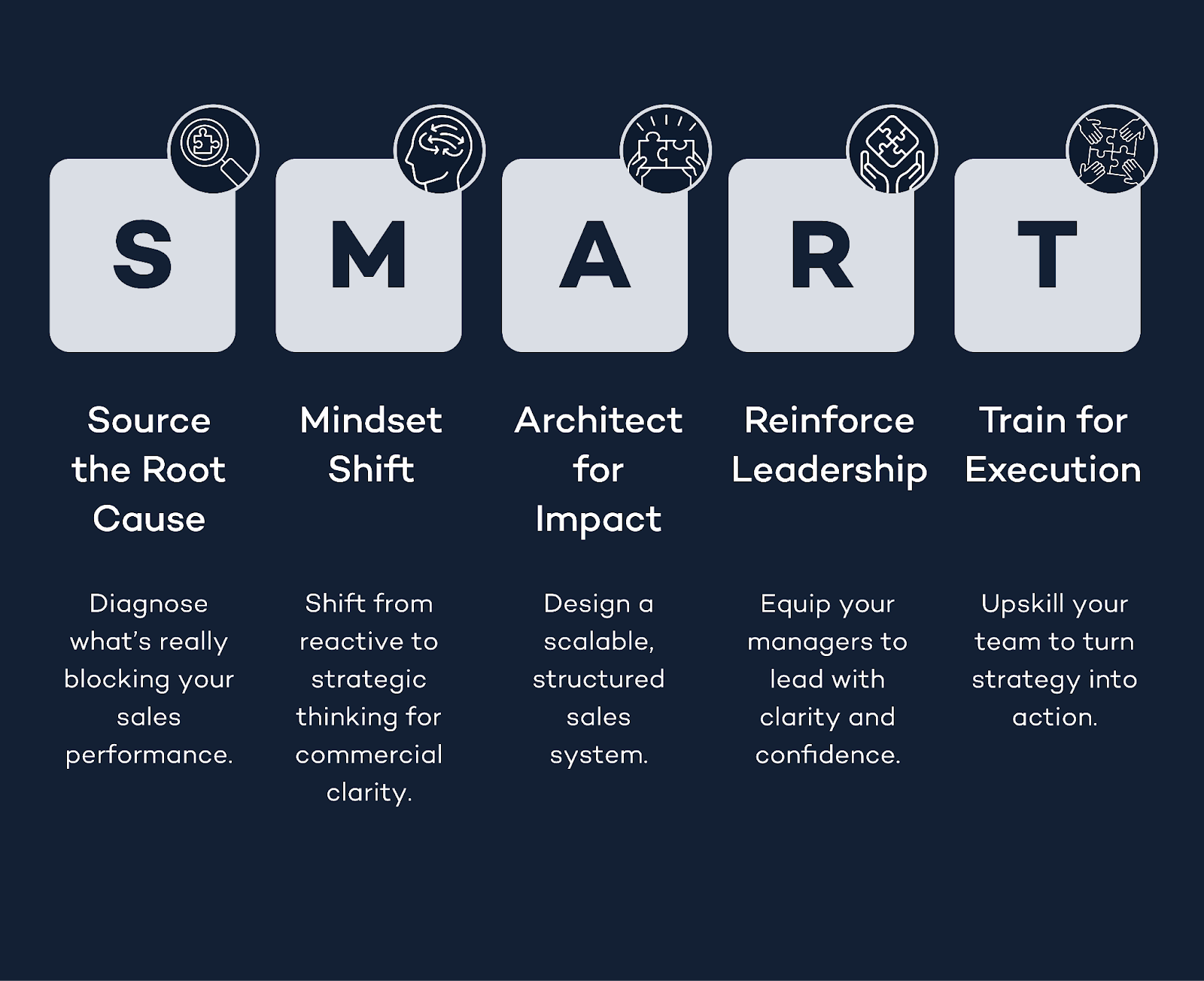
This is what our SMART Framework calls Reinforce. The leadership alignment stage before training the team at scale.
Most founders skip straight to “Train” and then wonder why nothing sticks.
Final Thought: Recruitment Is Not the Beginning. It’s the Middle
The most important mindset shift is this:
Recruitment is not how you fix sales.
Recruitment is how you scale sales once the foundations are in place.
The exact philosophy behind our sales accelerator approach.
If your system isn’t ready, no recruit will save you.
But if your system is strong, even a less experienced recruit can excel quickly.
Clarity creates performance.
Structure creates confidence.
Process creates consistency.
Coaching creates growth.
And that’s how you hire the right salesperson and set them up to win.
The same foundation that underpins every effective b2b sales accelerator programme.